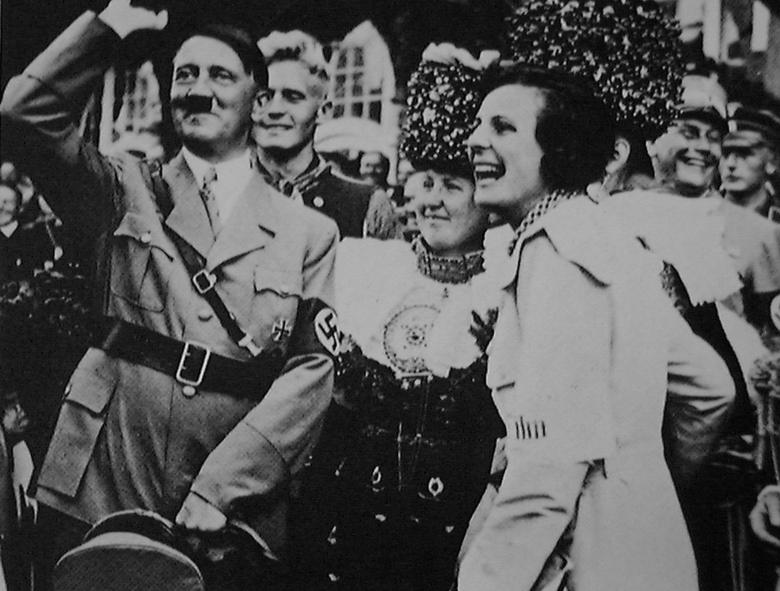
On Hitler’s express orders, and working to a title, The Triumph of the
Will’ [sic], which he himself had devised, the talented young film
director Leni Riefenstahl, whose adulation of the Fhrer never brought
her to apply for Nazi Party membership, was commissioned to film the
[1934] Reich Party Rally.’

To explore the ways in which Triumph of
the Will (Germany: 1934 L Riefenstahl) represents Nazi ideology it is
important to consider the events preceding the film’s production. Led by
Ernst Rhm, the Sturmabteilung, or SA, were a paramilitary organization
which helped the Nazi Party to power in 1933. As the SA gained in
numbers Rhm declared that The SA is and will be the arbiters of
Germany’s fate’ . However, deeply offensive to the sense of public order
and morality of middle-class Germans’, the power-crazed SA, also known
as brownshirts, were seen as the unacceptable face’ of the Party . Under
pressure by the German establishment including the army, Hitler ordered
for the massacre of Rhm and other SA officials on June 30th 1934, known
as The Night of the Long Knives’ . As will be discussed later, this
event is the motive for much of the representation of the Rally in
Triumph.
Nazi propaganda minister Joseph Goebbels had initially commissioned a
film to be made my Walter Ruttman to offer an ideological representation
of the historic facts of the National Socialist movement’s story’ .
However in doing so, Ruttman would have provided a document for the
German people and for its freedom movement’ , an approach contradicting
Hitler’s vision and indeed Leni Riefenstahl’s final representation. In
addition, Winston asserts that the importance of Triumph of the Will lay
in the account both the event and the film offered of the aftermath of
the Rhm putsch’; Ruttman’s historical documentary could have
immortalized Rhm’s contribution to the Party. Instead, Hitler’s
preference was for a documentation of the Nazi Party’s present moment of
triumph.
An examination of Nazi propaganda as a whole will provide a basis for
analysis of Triumph. Reeves expounds that Hitler’s idea of propaganda
was drawn from Lenin’s assessment that its success relies on adjusting
the intellectual level to the most limited intelligence of the
addressees; Nazi propaganda should have clear and simple messages. Welch
concurs, assessing that with a focus on the symmetry and order of Nazi
art, political propaganda such as Triumph, represents how individuality
is sacrificed for an ordered participation on a mass scale’. Moreover,
in an early speech to press representatives Joseph Goebbels further
exemplifies the idea of eradicating individuality by stating that the
regime’s aim was to work on people until they are addicted to us’ .
The
principal driving force of Nazi ideology was vlkish discernment which
idealized a mythical past where the German people had fulfilled their
destiny of a stable, racially pure, rural community, rooted in the soil
of the homeland, entirely at one with its natural environment’ . Vlkish
thinking suggested that Jews were part of the cause of the erosion of
these ideals because they embodied the materialism and the corruption of
city life that overtook traditional German values . As a result, much
of Nazi art and propaganda relied on a separation of good and evil with
an aim to eradicate the sinful and create a new, racially pure Germany.
In this way Volkish ideals use Darwin’s theory of evolution; an emphasis
on the natural selection of the strong i.e. racially pure Germans, over
the weak i.e. Jews and other racially impure humans. In addition it was
theorized that a leader who combined the power of the philosopher with
the courage of the German medieval knight’ would be the leader in
regaining the former greatness. Nazi art and propaganda was therefore
fashioned around the Fhrer cult; Hitler as Germany’s saviour. For
example, Hubert Lanzinger’s painting The Flag Bearer’ depicts Hitler in shining armour representing him as the German medieval
knight’ who will save Germany.
The Flag Bearer’ also depicts further
symbolism connected to Nazism; the inclusion of a flag bearing the Nazi
Swastika symbol represents the militarized power of the party. As a
trend in Nazi propaganda, Reeves recognizes that enormous emphasis on
military symbols’ in Triumph triggered deeply felt emotions associated
with Germany’s former military might’. Finally, the painting links old
and new ideals; the traditional armour as the old idyllic and Hitler as
the new redeemer. Reeves15 suggests that the uniting of old and new in
Nazi propaganda reveals their visions of a mythical past being
translated into the contemporary reality of gas chambers and racial
extermination. This article will now analyze how the aforementioned Nazi
beliefs are ideologically encoded within Triumph of the Will.

Leni
Riefenstahl’s editing provides an insight into the status of Triumph of
the Will as Nazi propaganda. For example, one sequence during Hitler’s
arrival in Nuremburg is composed of four shots; the first two shots show
the old buildings of the city and then a German flag therefore
representing the old, traditional Germany. The following two shots
depict Hitler and then a Swastika. This sequence typifies how
Riefenstahl has represented the Nazi ideology of a return to a mythical
epoch by linking the ideals of the traditional dogma with a visionary
future. Similarly, before the scene of the city awakening Riefenstahl
links a shot of an old church to represent Vlkish thought, with the
rally camp site to signify the new Germany. Incidentally Hinton suggests
that as result of these sequences, Triumph of the Will is more than a
document of the 1934 Nazi Party Rally; it is a document of the city of
Nuremburg’ where the viewer gains a sense of the beauty and history of
the medieval centre. Furthermore, the use of German and Nazi flags ties
in with the use of military symbols inherent in the propaganda of the
Third Reich.
An ideological reading of Triumph in support of the
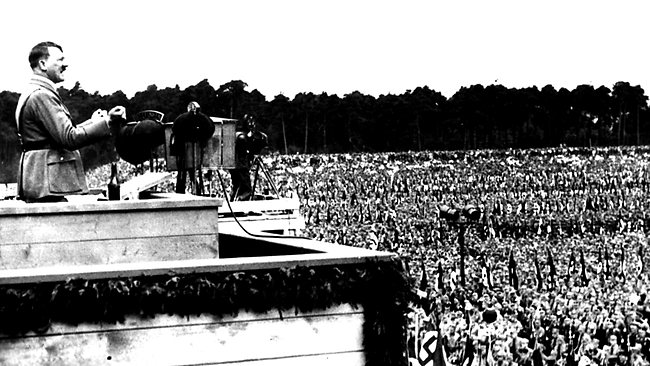
Fhrer cult stems from Riefenstahl’s editing of the Rally speeches. The
first speaker at the Rally was Deputy Leader of the Nazi Party Rudolph
Hess who was then followed by other officials. While the other speeches
were edited to short excerpts, Riefenstahl allowed Hess a full speech on
the final film. The length of time devoted to Hess compared to other
officials in this sequence therefore emphasizes his dialogue in which he
exemplifies the Fhrer cult of Nazi propaganda:
“You [Hitler] are
Germany. When you act, the nation acts; when you judge, the people judge
[] Thanks to your leadership, Germany will attain her aim to be the
homeland of all the Germans in the world. You have guaranteed our
victory, and you are now guaranteeing our peace. Heil Hitler! Sieg Heil!
Sieg Heil! Sieg Heil!”
In addition, the segment is intercut with
shots of eagles, swastikas, the crowd and of a large sign at the
opposite end of the hall which reads: “Alles for Deutschland”
(Everything for Germany)’ ; these shots further affirm Hitler’s place as
Germany’s representative, as their saviour.
Another lengthy speech
is devoted to Ernst Rohm’s replacement Viktor Lutze when he addresses the
SA. While Riefenstahl’s inclusion of the Hess speech typified the Fuhrer
cult, Lutze’s speech was designed to affirm his own position as leader
of the brownshirts and to regain their allegiance to Hitler; “We SA men
have known only one thing: fidelity to, and fighting for the Fuhrer”. By
keeping in footage such as Lutze’s car being enthusiastically surrounded
by SA men trying to shake his hand’ , Riefenstahl chose to focus on
unifying the faction’s comrades. Furthermore, to accentuate this point
the SA ceremony was the only event included in the film but not in the
official programme . By including the sequence Riefenstahl is therefore
noting the significance of the SA petition in the context of the film,
exaggerating its purpose as Nazi propaganda and acknowledging what was
required of her as a filmmaker.
6.jpg)
Similarly in the aftermath of the Rohm
purge, Hitler’s speech to the SA was the climax of Triumph. Although
diarist Burdon noted the evident tension in the stadium’ and ‘Hitler’s
own bodyguard [] drawn up in front of him’, Riefenstahl’s editing
deemphasizes any friction. Moreover, the Fuhrer cult is further embodied
by categorically establishing Hitler’s power and status as Germany’s
leader. For example, in his speech to the brownshirts Hitler distanced
himself from blame of the Rohm putsch:
“A few months ago, a black
shadow spread over the movement [] only a lunatic or a deliberate liar
could think that I, or anybody, would ever dissolve what we ourselves
have built up”19
This highlights how Riefenstahl edited the speeches
as well as visual iconographies to manipulate the audience and affirm
Nazi ideology. However, Hitler’s speech could be condemned as poor and
evasive; Barsam claims that under the scrutiny of the close-up lens’
Hitler appears as an excited politician carried away with himself’ and
suggests that he perhaps fails to live up to the image that the
preceding film has created for him’.
Rother suggests that
Riefenstahl’s editing techniques represent two relationships; firstly
the illustration of a love story with Hitler’, and secondly unilateral
commitment to Hitler’. Riefenstahl achieves the former relationship in
the opening sequences of the film. As Hitler is driven through the
streets of Nuremburg the pattern of shot and reaction-shot between the
Fhrer and the people create a key link between the masses and Hitler as
object of the gaze. Seeking to promote Hitler as champion of women and
children’ Riefenstahl matches shots of crowds on the left to a shot of
Hitler looking to the left to maintain an illusion of a privileged gaze.
By focusing on the crowd’s adulation and enthusiasm for their Fhrer the
film proposes Hitler’s love story’ with Germany’s women and children.
As Hitler stops to receive flowers, for example, Riefenstahl cuts to
reaction-shots of children laughing with devotion, reinforcing the Fhrer
cult for the audience.
The latter relationship of commitment to
Hitler is apparent in the submission of men to their Fhrer. Riefenstahl
achieves this proposition using shots of the parades and close-ups of
the men intercut with shots of Hitler. In contrast to the love story’,
Hitler is often shown in long shots during the parades. Rather than
undermine the film’s ideological impact these shots remind the audience
that the Rally’s rituals revolve around Hitler , which therefore
confirms his status by emphasizing the men’s submission. Barsam also
notes the ground-level shots of the men’s knee boots during the opening
love story’ where the soldier’s act as a fence. This creates a
threatening aura as the human barrier affirms the Fhrer cult; Hitler is
divorced from the status of ordinary citizen and the soldiers are
de-individualized into a symbol of the Fhrer’s power.
To attain an
effusive ideological and emotional narrative, Leni Riefenstahl reordered
the chronology of the Rally. She talked of the rhythm and melody of a
documentary film; There are valleys, there are peaks. Some things have
to be sunk down, some have to soar’ . For example, Riefenstahl found
that the city awakening sequence lacked impact and therefore placed it
as a valley’ after the opening peaks’ of the film. Although the sequence
was shot around September 7th (1934), three days after Hitler’s
arrival, the sequence provides an ideal representation of the excitement
after advent of the Fhrer . By reordering the narrative in such a
Riefenstahl heightens the emotional impact, allowing the audience time
to reflect on the previous scenes. The film therefore manipulates
reality to emphasize its purpose as propaganda of the Third Reich; the
text is more emotive than informative.
Triumph of the Will includes
many examples of symbolic encoding which connotatively ascertain the
Fuhrer cult. Riefenstahl combines Vlkish ideas of racial and religious
purity with Hitler’s self-professed status as Germany’s saviour to
represent the Fhrer as a semi-god. The opening sequence is arguably the
most enigmatic scene of the film by highlighting the grandeur of the
Fhrer. The film’s status of propaganda is heightened in the sacrifice of
documentary convention for narrative amplification i.e. the film makes
an ideological statement before any factual testimony. Beginning with a
dark screen and the Nazi icons, an eagle and a swastika, text describes
Germany’s misgivings since World War I. Immediately after this, the film
opens in a cloudscape as the camera follows Hitler’s plane over
Nuremburg. The contrast of these two shots already suggests Hitler as
the light to end Germany’s darkness. As the plane flies over the city,
its shadow casts a cruciform shape over the old buildings and marching
Party members. By filming from Hitler’s point-of-view Riefenstahl
advocates the blessing’ of his faithful followers as the Fhrer touches’
the marching columns therefore creating a tone of insistent messianism’ .
Immediately the film supports the Fhrer cult; the opening sequence
connotes Hitler as godlike, descending from the Heavens to be Germany’s
devout saviour. In addition this establishing compositional technique of
travelling through clouds was already a convention of Riefenstahl’s
from her previous mountain films . Considering this practice Rother
suggests that Triumph uses the notion of the spectacular to introduce
the film as privileging exhibition over report. Furthermore the film is
instantly emphatic of depicting Hitler as a solitary figure of isolated
strength ; as mentioned above, the film divorces the Fhrer from the
ordinary.
Riefenstahl continues a religious thesis throughout the
film. As Hitler travels through Nuremburg upon his arrival, the palm of
his hand catches the light. The symbolic effect of this shot reinforces
the messianic presence of the Fhrer’ by proposing a halo quality which
illuminates Hitler therefore affirming his presence as Germany’s
spiritual leader. Similarly, in the same sequence Riefenstahl depicts a
cat on a ledge turning around as if to look at Hitler as he drives by.
By following this with Hitler briefly looking up, Riefenstahl is
proposing a link between the shots. She symbolically emphasizes Hitler’s
godlike eminence by representing him as all-knowing; not even a cat on a
window sill escapes his contemplation. As an example of Nazi
propaganda, the film uses shots such as the cat to emotionally grip the
audience by privileging all creatures with his gaze Hitler is depicted
benevolent and kind-hearted.
As mentioned above an emphasis is placed
on military symbols in Nazi propaganda. Riefenstahl uses such motifs
throughout Triumph to affirm Hitler’s status as well as emotionally
capture, or hypnotize the audience into the inflection of military
practice. Reeves expands on the task Nazi propaganda faced:
In
recognizing the necessity of the battles ahead, the nation would indeed
become the fighting community as war approached, psychological
mobilization would parallel military mobilization; in war, the people’s
morale would be strengthened and reinforced’.
An example of Nazi
militarization is in the Labour Corps sequence where the men stand as if
their soldiers in perfect formation with spades handled as if the were
guns. Riefenstahl uses these ideas and repeatedly exposes militaristic
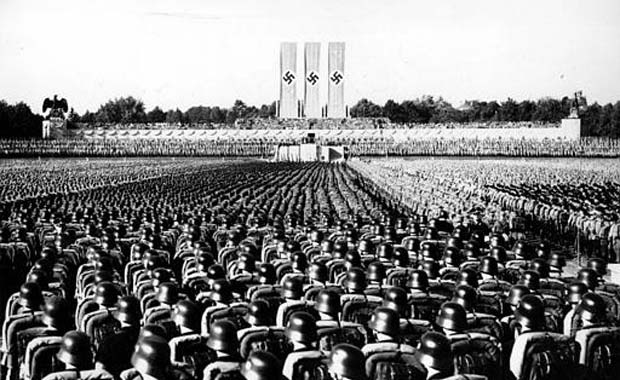
symbols to reinforce the regime’s philosophy. The evening rally depicts a
mass of flags; the party members have been de-individualized to the
status of military symbols. By refusing close-ups of the men she is
representing them as a mass to connote the strength of Germany. However,
while the crowds are rendered faceless, literally as well as
figuratively’ , Hitler is illuminated by the searchlights and by
Riefenstahl’s photography therefore symbolizing that he is their leader
and the only individual.
Use of music in Triumph strengthens further
the link between old and new Germany. Riefenstahl used Herbert Windt to
accompany her film with music in the style of composer Richard Wagner, a
Nationalist idol of Hitler’s who himself called for the extermination
of the Jews. This combination of old and new music fits the aim of Nazi
propaganda to unite Vlkish ideals and Germany’s rebirth. Similarly, the
score continually reinforces Riefenstahl’s intentions throughout the
film; as the prologue remarks of the sufferings of Germany since the
World War I the music has a mournful tone. However, as the text reads of
Germany’s rebirth in the form of the Nazi Party, the music is upbeat
and triumphant. Windt’s mixture of traditional folk music with Nazi
songs and national anthems suggests the continuation of an ancient music
tradition’ . The overall effect of the score is to reassure the
audience using familiar Germanic themes and clear tones in keeping with
the simplicity of Nazi propaganda.
This article has considered the
main themes of Nazi propaganda and how these are represented in Triumph
of the Will. Although Rother points out that it would have been
surprising if Triumph des Willens had failed to fulfill its ideological
purposes’, there is some debate as to whether Leni Riefenstahl
intentionally encoded Nazism. After the film’s production Leni
Riefenstahl claimed she knew nothing of politics or of the Nazi Party; I
have not one moment thought of Rohm, Hitler mentions this because it
was coming out from this and so he mentions this. But I have not one
thought to make this’. However, in contradiction Leni Riefenstahl
revealed that the preparations for the rally were produced in
conjunction for the camerawork . Regardless of Riefenstahl’s
contradictions the Rally was not a neutral event; For example, as the
battles of World War I are read out, flags are lowered visually
symbolizing the disgrace of Germany with each defeat’, however the flags
are raised to connote Hitler’s raising of the dead and Germany’s
rebirth. The symbolism of the rally in itself was powerful.
However
whether the film was intended to simply be a document of the 1934
Nuremburg rally or rather a piece of Nazi propaganda, the implications
and readings of the film remain the same. Moreover, where the film and
Nazism are inevitably linked so too are the weaknesses of the film. The
over-emphasis of Vlkish ideology and display of Nazi power reduce some
scenes to monotonous: the main parade of various forces through the
streets of Nuremburg was to represent the strength of Germany. However,
as Riefenstahl tries to connote progress through the use of a moving
camera the combination of this with the marching columns creates a
tedious effect.
In the shift from Hitler, as spiritual leader, to
Hitler as head of military forces’ the lies of Nazi ideology are
exposed. Barsam suggests that the film’s overall weakness lies in the
discernable gap between historical reality and cinematic illusion’. For
example, Triumph exposes the militarization of party members and youths
to represent a nation readying itself for war. However, as Kershaw
writes, Hitler was understood to be Germany’s guarantor of peace. The
weakness of Triumph therefore rests with its exposure of the
contradictions of Nazism. In later years Hitler admits to this illusion:
Only
through emphasis on the German desire for peace and intentions of peace
was it possible for me to provide the German people with the armaments
which were always necessary as the basis of the next step’.
Parenthetically,
Riefenstahl failure to contain the lies of Nazism contributes to film’s
advantage as anti-Nazi propaganda. It could be argued that as a
documentation of a Third Reich event the visual blatancy of the
glorification of the Nazi Party and the deification of Adolf Hitler’
attests its usefulness for the purposes of anti-Nazi philosophy.
In
conclusion, the themes of Triumph of the Will repeatedly affirm its
status as an archetype of Nazi propaganda. The film serves to unite old
Germany with the present moment of triumph and to implicate Germany’s
future as positive under the Fhrer’s leadership. Triumph also aims to
regain the trust of the SA and to affirm Hitler’s status as the German
saviours of vlkish thought. Furthermore by using iconic nature metaphors
such as a forest of flags and the opening mountain-like grandeur the
text implies a Darwinism of natural selection, in which the Germans will
triumph.
Whether the impact of the film was intentional or
otherwise, the ideologies portrayed produced a terrifying picture of a
new Fascist state’ to the rest of the world. As the film continually
supports the Fhrer cult, the de-individualizing of the German people
proves haunting to the modern audience who inevitably fail to divorce
the film from the infamous atrocities of the Third Reich. However in
this way the film is genius in its fulfilment of its objective. As Welch
summarizes:
“[...] the individual participant in the ritual,
fanatically moved by Hitler’s rhetoric and swayed by the crowd,
underwent a metamorphosis in Goebbels’s famous phrase from a little worm into part of a dragon’”40.
References:
Barsam, R.(1975) Film Guide to Triumph of the Will Indiana University Press, USA
Hinton, D (2000) The Films of Leni Riefenstahl Scarecrow Press, London
Kershaw, I (1987) The Hitler Myth’: Image and Reality in the Third Reich
Oxford University Press, Oxford
Reeves, N. (1999) The Power of Film Propaganda: Myth or Reality Cassell, London
Rother, R. (2002) Leni Riefenstahl: The Seduction of Genius Continuum, London
Welch, D. (2001) Propaganda and the German Cinema 1933-1945 I. B. Tauris Publishers, London
Winston, B. (1995) Claiming the Real: The Documentary Film Revisited British Film Institute Publishing, London
Yoder,
B (date unknown) Nazi and Soviet Art: The Flag Bearer [online]
Available at http://www.goodart.org/nzhorse.jpg Accessed 30/04/2006
Filmography:
Riefenstahl, L. (Germany: 1934) Triumph of the Will
URL to article:
http://www.entertainmentscene360.com/index.php/movie-analysis-nazi-ideology-in-leni-riefenstahls-triumph-of-the-will-44604/