Senior Lecturer in Modern German History, University of Huddersfield
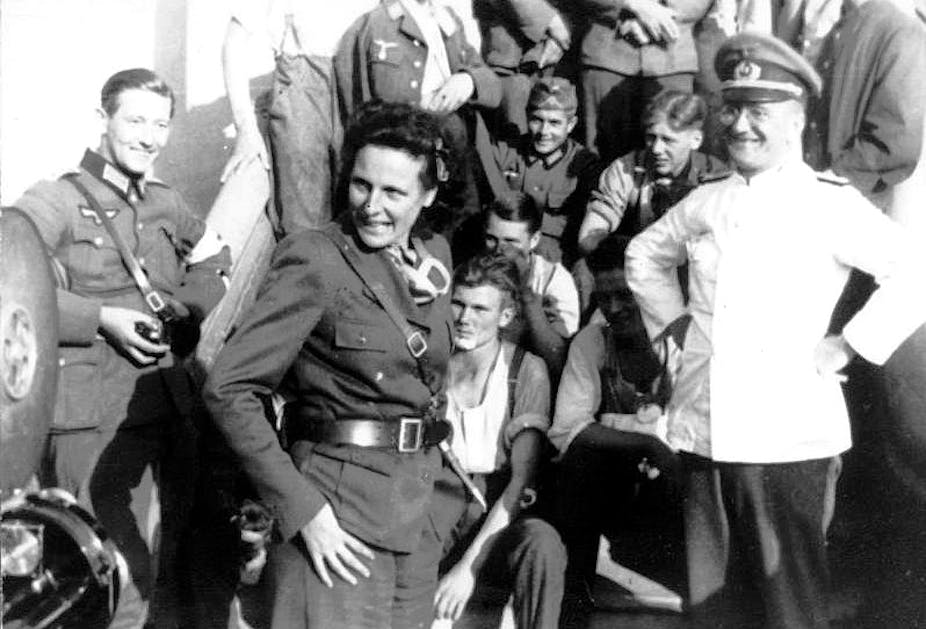
Leni Riefenstahl as war correspondent in Poland 1939, wearing a Wehrmacht uniform.
German Federal ArchivesThe dancer, actress, director and photographer Helene “Leni”
Riefenstahl, who died in 2003, is a controversial character, largely
because of the many propaganda movies she produced for the Nazis. So
when it was recently announced
that her estate would be handed over to a Berlin photography museum,
historians of the period hoped to find some clarification about the
extent of her involvement with the Nazi regime.
But these hopes are likely to be dashed. Riefenstahl, like many other celebrities of the Third Reich, was wise enough to destroy incriminating evidence
at the end of World War II and created the image of herself as a naïve
opportunist through interviews, autobiographies and – often enough –
libel cases.
Riefenstahl’s cinematic legacy,
particularly in sport journalism, is undeniable. This is why Germany’s
most prolific feminist, Alice Schwarzer, has criticised historians and
journalists who always bring up Riefenstahl’s past involvement with the
Nazis, while supposedly being more lenient towards male Nazi celebrities.
But this is demonstrably untrue. Male artists, such as conductor Wilhelm Furtwängler, have been equally criticised for being co-opted
by the Nazi regime. Schwarzer may have a point that other artists did
not experience the same scrutiny after 1945. But her movies in the 1930s
are prime examples of Nazi propaganda. Male filmmakers who produced
such brazen propaganda on similar levels, however, got similar
treatment.
Riefenstahl would later claim that Goebbels hated her and only
Hitler’s patronage spared her from trouble. But this has never been
substantially backed up by evidence. Riefenstahl’s acquaintance with
Hitler goes back to 1932 when they met for the first time – after she
wrote to him requesting a meeting.
Riefenstahl, who made a name for herself in the 1920s as an actress
and then as a director in the early 1930s, became a star in the then
popular genre of “mountain movies”.
This was a topic dear to the Nazis and other nationalists in Weimar
Germany who saw mountaineering – man’s struggle with nature – as both a
symbol for Germany’s post-World War I struggle and the
social-Darwinistic model of the survival of the fittest. Riefenstahl’s
1932 movie The Blue Light,
which she directed and had the leading role in, reportedly became one
of Hitler’s favourite movies. Its plot featured some of the main tropes
of Nazi ideology: the perils of greed and materialism represented by
sinister foreigners.
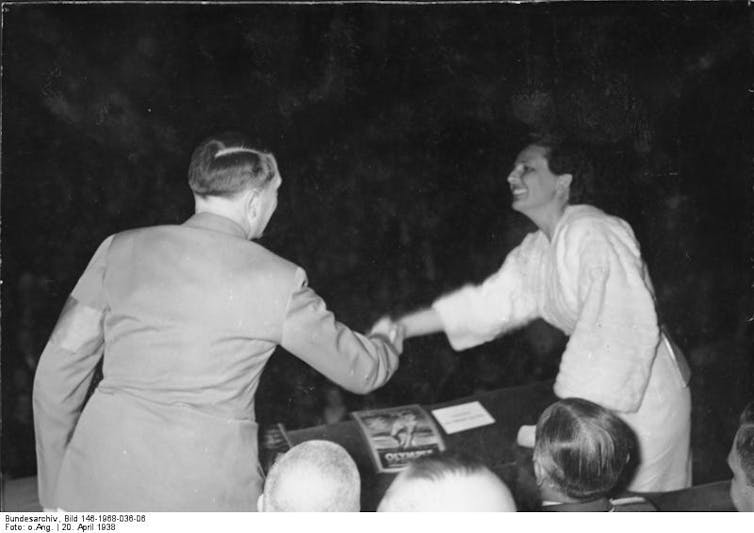
Leni Riefenstahl and Adolf Hitler in 1938 at the premiere of her first Olympia movie.Bundesarchiv/Wikimedia
Nazi era
After the Nazi Party came to power in January 1933, Riefenstahl
turned her close links to Hitler into a profitable venture. Riefenstahl
was commissioned to produce films on the annual Nazi Party rallies in
Nuremberg 1933 and 1934, Victory of Faith and Triumph of the Will,
respectively. The latter, in particular, is regarded as a cinematic
milestone for using novel techniques in visual storytelling.
Riefenstahl would defend herself after the war by saying that these,
like her two movies on the Berlin Olympics, were documentaries rather
than propaganda movies – there is no narrator in the film and thus no
explicitly stated political agenda. But when you see the films, there is
really no need for a narrator. The opening sequence of Triumph of the Will
is a plane carrying Hitler to Nuremberg, to be greeted by an
enthusiastic crowd upon landing. This descent from the heavens echoes
Nazi propaganda that Hitler was sent by providence to rescue Germany. As
renowned art critic Susan Sontag wrote in 1975:
In Triumph of the Will, the document (the image) is no longer simply
the record of reality; ‘reality’ has been constructed to serve the
image.
Her two movies on the Olympic Games carry similar images. According
to Riefenstahl, she only wanted to celebrate the aesthetics of athletic
bodies – a claim reflected in the title of the second movie: Festival of
Beauty. This, obviously, corresponds with the Nazis’ idea of purity and
athleticism as signs of the virility and the superiority of the “Aryan”
race.
As Sontag points out, Riefenstahl remained true to this ideal after
the war, even when no longer focusing on white people. Her 1975 photo
book on the Sudanese Nuba tribe also focused on the young, male,
muscular body – promoting once more the ideal of a body image that
cherishes the healthy and athletic form. In Sontag’s eyes, this focus on
athleticism “can be seen as the third in Riefenstahl’s triptych of
fascist visuals” – following in the footsteps of her movies on mountains
and the Olympics.
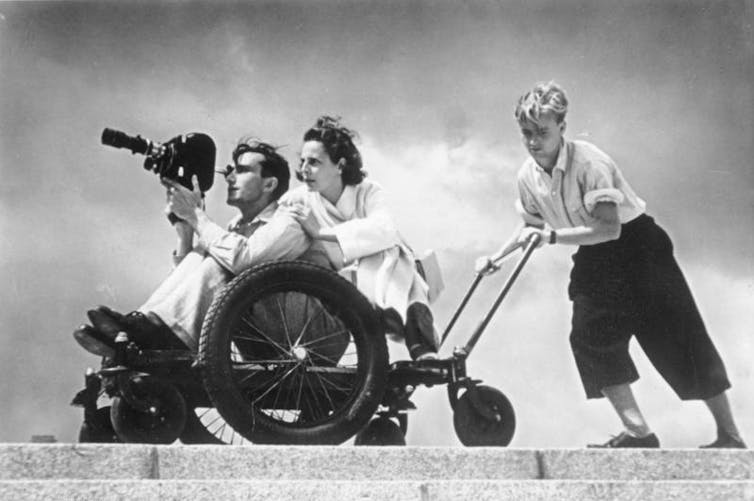
Riefenstahl filming at the 1936 Olympics.Bundesarchiv/Wikimedia
Faustian pact
Schwarzer’s attempt to somewhat exculpate Riefenstahl by arguing that
she had to cooperate with the Nazis in order to make a career as a
woman seems a bit facile. Riefenstahl and the Nazis found each other
because they had similar ideas about the body, society and their
representation. Riefenstahl may not have been a card-carrying Nazi in
the sense of anti-Semitism or thirst for war – although her post-war
excuse that she didn’t witness atrocities during her time as war
correspondent has been debunked by historians. But her aesthetics and her understanding of community and mysticism went hand-in-glove with Nazi ideology.
Worryingly enough, as Sontag pointed out, these aesthetics were
rehabilitated in the 1970s with the rise of the body-building movement.
Celebrating the beauty of the athletic body became in vogue again, and
also led to a rehabilitation of sorts for Riefenstahl.
Her contributions to film history are undeniable. Many techniques
that are now seen as common in sports reporting were introduced and
championed by her Olympia movies – such as cameras on dollies to follow
the athletes on the track or underwater cameras in the swimming and
diving competitions to give a perspective to viewers that even
spectators in the stadium wouldn’t get.
So maybe Leni Riefenstahl is such a controversial figure because she is both a feminist, and a Nazi, icon.